? "width=device-width,initial-scale=1.0,minimum-scale=1.0,maximum-scale=1.0" : "width=1100"' name='viewport'/> Deriv crypto

Friday, 18 August 2023

What Is Bitcoin in 5 Minutes

 Bitcoin is a revolutionary asset class where value is represented not as a physical or digital object, but as a record of ownership on the Bitcoin blockchain.
Gemini-What Is Bitcoin in 5 Minutes

Summary

You may have heard bitcoin being called “digital gold” or “cash for the internet” but those descriptions don’t really tell you much about it. If you want to know what bitcoin really is and how it works, you’ve come to the right place.

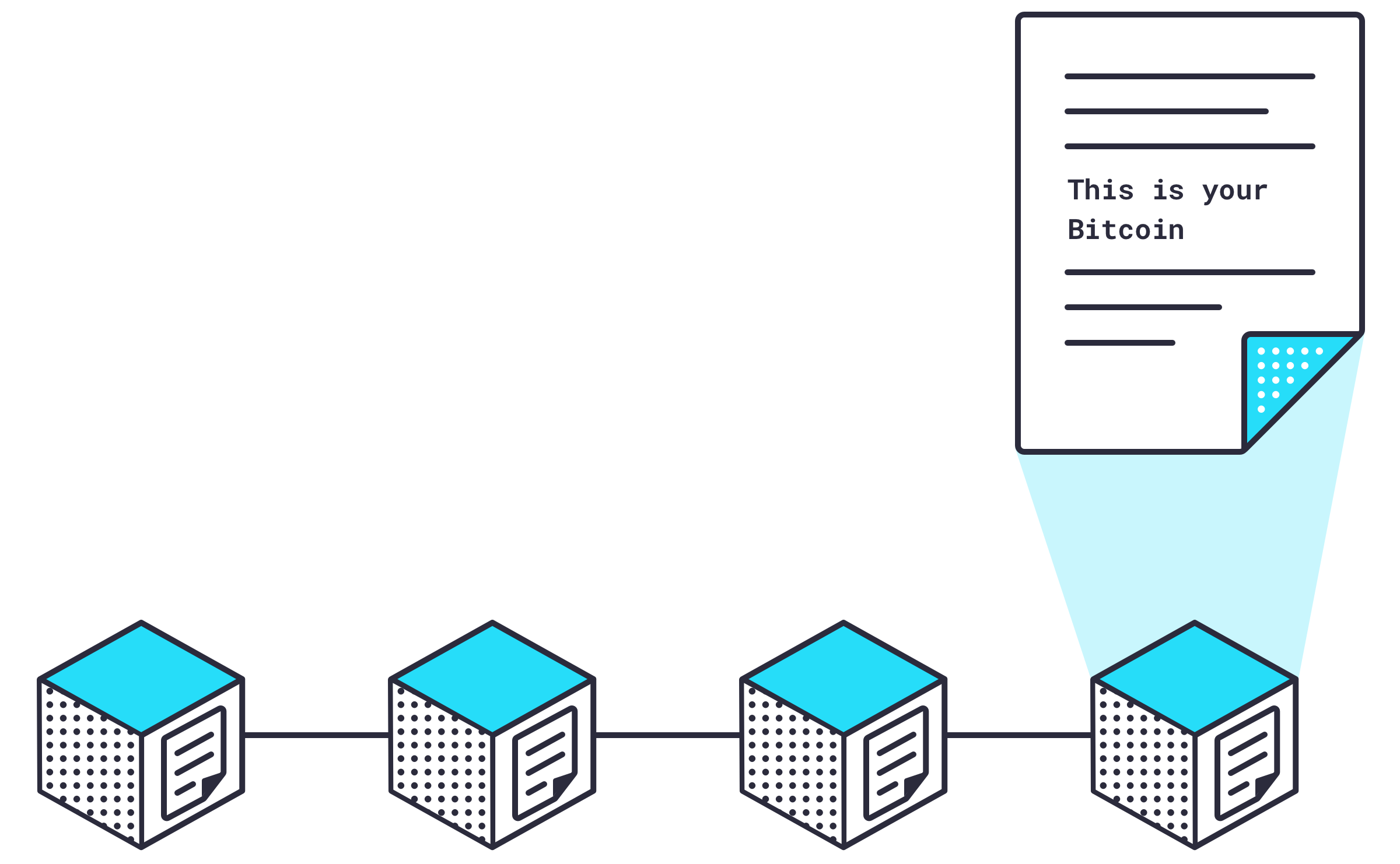
Gemini_Bitcoin_in_5_minutes-Image_1.png

Understanding Bitcoin

Bitcoin is not a physical or digital object. Rather, bitcoin (BTC) is a representation of value in the form of a record of ownership on the Bitcoin blockchain. While this may sound totally foreign to you, by the time you scroll down this page you will understand what bitcoin really is and how it works.

To understand bitcoin the record of ownership you must first understand Bitcoin the network, which is comprised of three things:

  1. the Bitcoin blockchain,

  2. bitcoin transactions, and

  3. the entities that verify and secure transactions.

The Bitcoin blockchain is simply a public record that has some very unique attributes that makes it incredibly secure and trustworthy. This public record exists on tens of thousands of computers around the world simultaneously, called nodes, and is updated in real time. No one person or business controls these nodes, making Bitcoin decentralized.
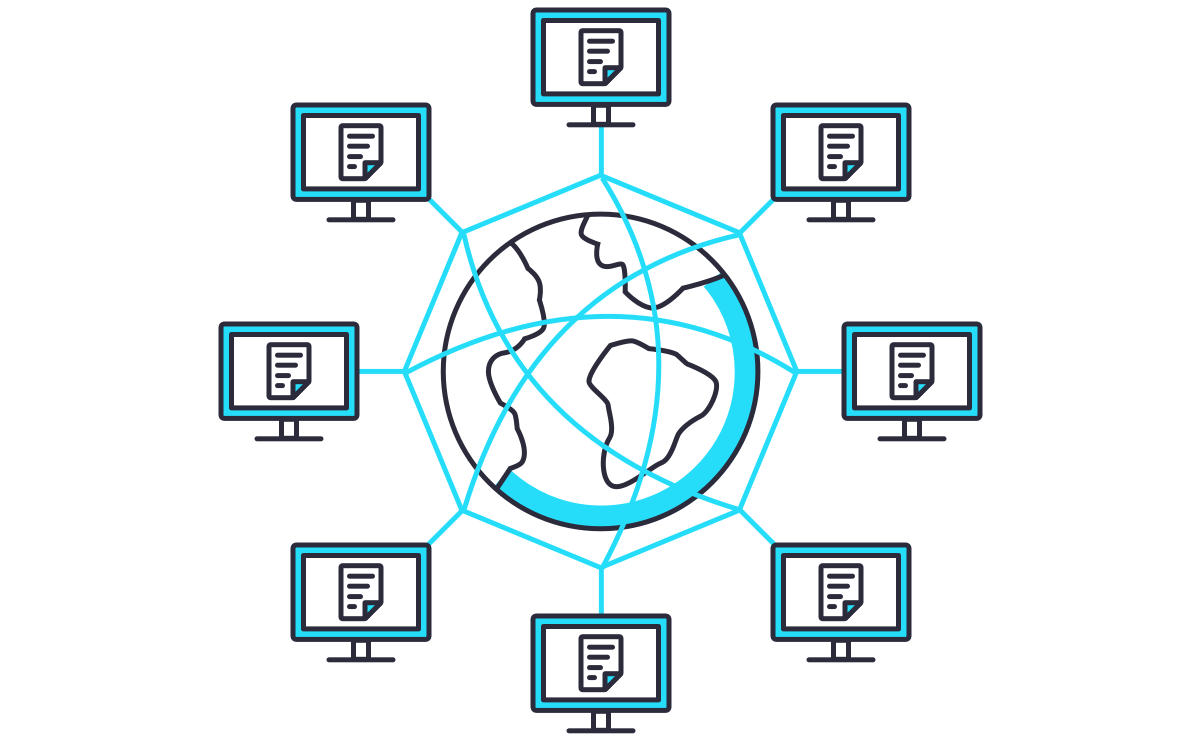
Gemini_Bitcoin_in_5_minutes-Image_2.png

Bitcoin transactions are just like every other financial transaction you’re already familiar with: a transfer of value (e.g. dollars, real estate) from one person to another. But, instead of routing that transaction through a bank or other financial services provider, it’s validated, recorded and secured directly on the blockchain by all the nodes in the Bitcoin network. This process makes transactions on the Bitcoin blockchain secure and verifiable.

Bitcoin Nodes Decentralize the Network

Every bitcoin transaction is broadcast by the node where the transaction originated to all the nodes in the Bitcoin network. These nodes make sure that the transaction is valid, meaning they scan the entire blockchain to confirm that the person sending money indeed has that money and is authorized to send it. If those two conditions are met the transaction is deemed valid.

Remember that Bitcoin is decentralized, which means that thousands of Bitcoin nodes in aggregate have to agree that a transaction is valid. Even if a few bad actors validated a transaction falsely, thousands of other nodes would not, and the transaction would not be confirmed. This makes the probability that a valid transaction is recorded extremely high and the probability that a false transaction is recorded extremely low — making Bitcoin incredibly safe and secure to use.

Every 10 minutes or so, all the latest valid transactions are organized into a block of data which is then sent out to the entire network to be secured in the blockchain.
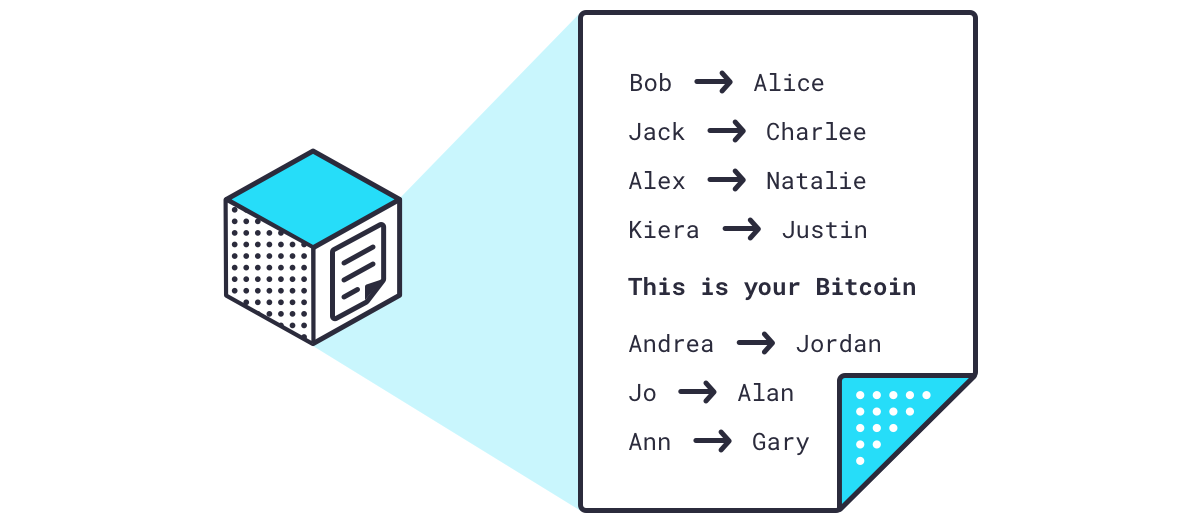
Gemini_Bitcoin_in_5_minutes-Image_3.png

So, let’s do a quick recap before we continue and explain how blocks of transactions are sealed, secured, and added to the blockchain.

  1. Bitcoin transactions are broadcast to all Bitcoin nodes.

  2. Transactions are validated and agreed upon by the network.

  3. All valid transactions are organized into a block of data approximately every 10 minutes.

  4. The unsecured block of data is sent out to the entire Bitcoin network to be added to the Bitcoin blockchain.

With us so far? Good. Now, on to the blockchain.

How Do Miners Verify Bitcoin Transactions?

A special subset of nodes called miners take unsecured blocks of data and do a couple of things to secure that block in the Bitcoin blockchain.

First they take every transaction in the block and run it through an algorithm that takes each transaction and creates a unique identifying signature of 64 letters and numbers called a hash.
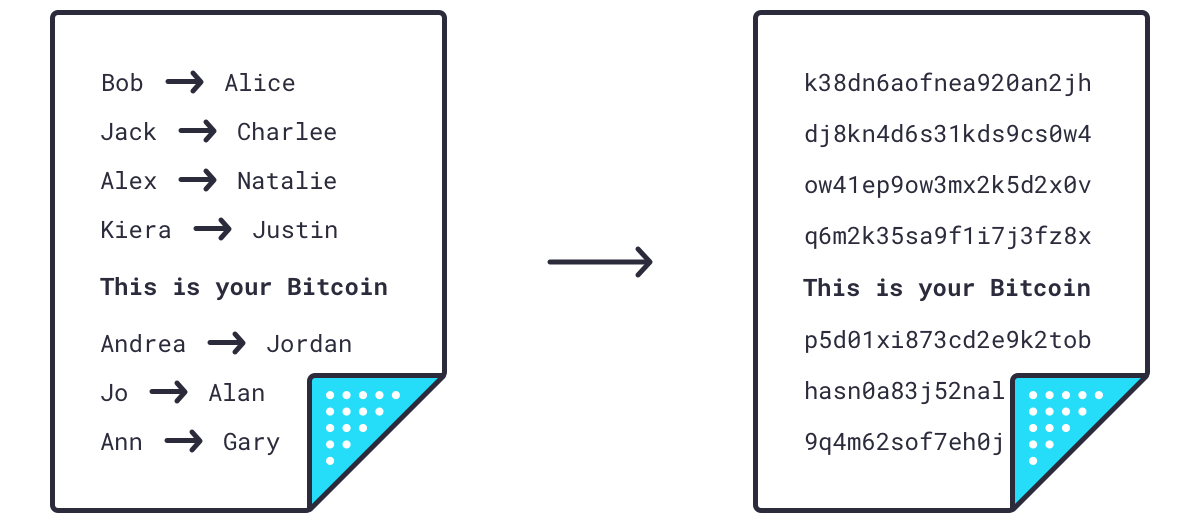
Gemini_Bitcoin_in_5_minutes-Image_4.png

So now we have a block of transactions that have been compressed into hashes. They are then compressed further by pairing hashes together and creating a new hash for the pair. This is done until the entire block of transactions is represented by a single hash.

Gemini_Bitcoin_in_5_minutes-Image_5.png

Then, the hash from the previous block is added to the block.
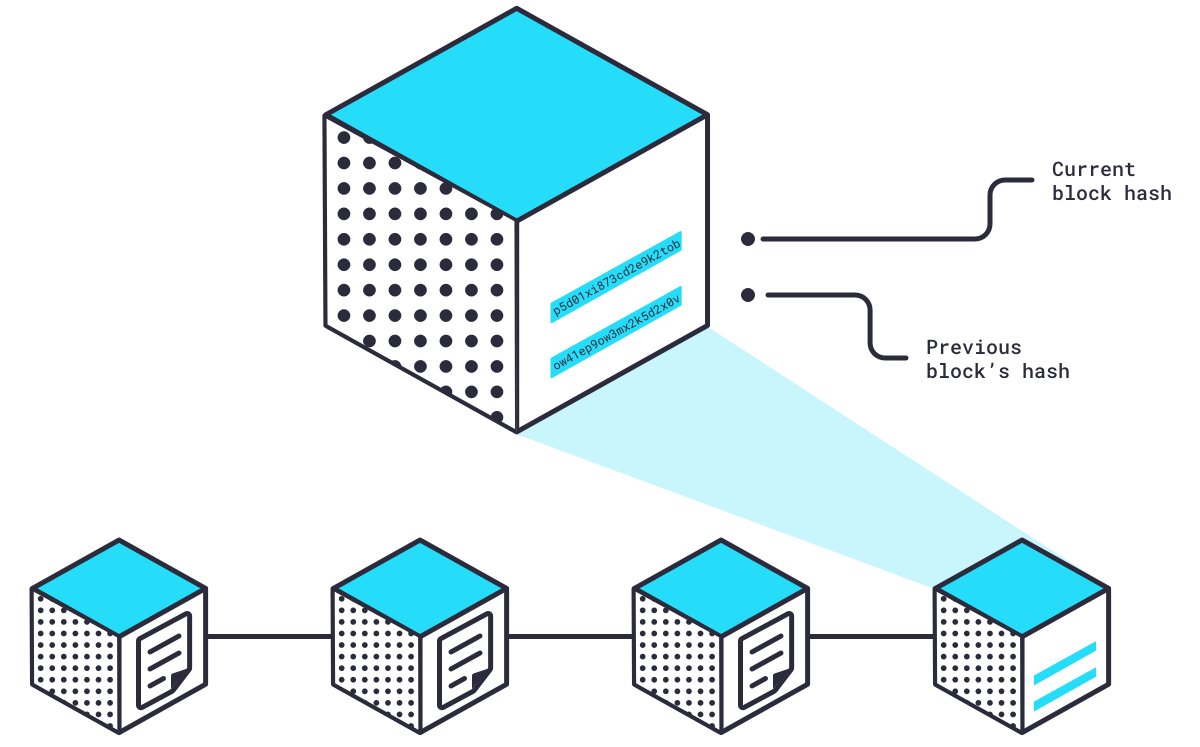
Gemini_Bitcoin_in_5_minutes-Image_6.png

So now our block has the hash that represents all the current transactions in the block and the hash that represents all the transactions from the previous block. This is how the “chain” in “blockchain” is formed. If a single byte of data from any previous block were to change, it would invalidate all future blocks because every single hash going forward would change and break the blockchain.

The final piece of the block is a random number called a nonce, and this is where the miners really get to work.

The nonce and the two hashes in the block together need to create a hash that meets a certain set of criteria established by the software that powers the Bitcoin network. The only way to find a valid hash is by trying random nonce numbers until the hash criteria is met.
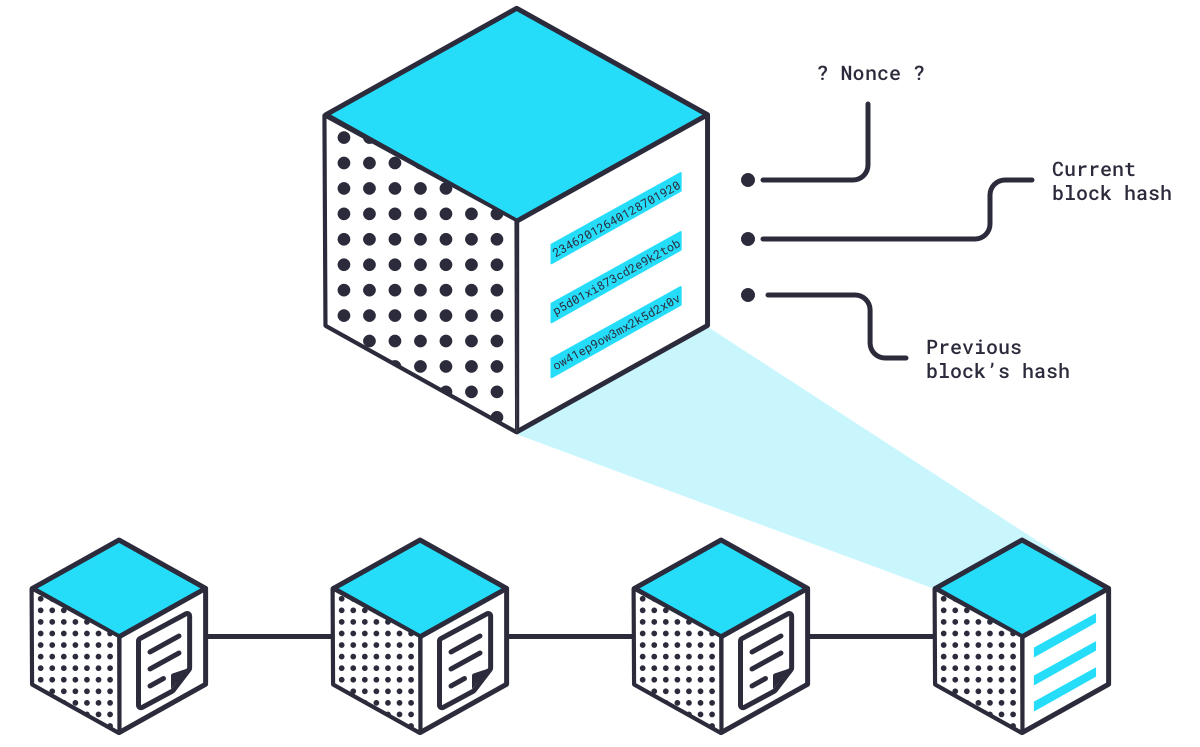
Gemini_Bitcoin_in_5_minutes-Image_7.png

Bitcoin Mining Rewards Power Blockchain Security

Miners buy or build special computers, develop algorithms, and spend a lot of time and energy in the form of electricity to find the nonce that meets this criteria. The first miner to find the nonce and create the hash that meets the criteria broadcasts the hash to the entire network.

While creating the block’s hash is very difficult, checking that it meets the criteria is very simple. Nodes verify that the block’s hash meets the criteria, then add that block to their copy of the blockchain.
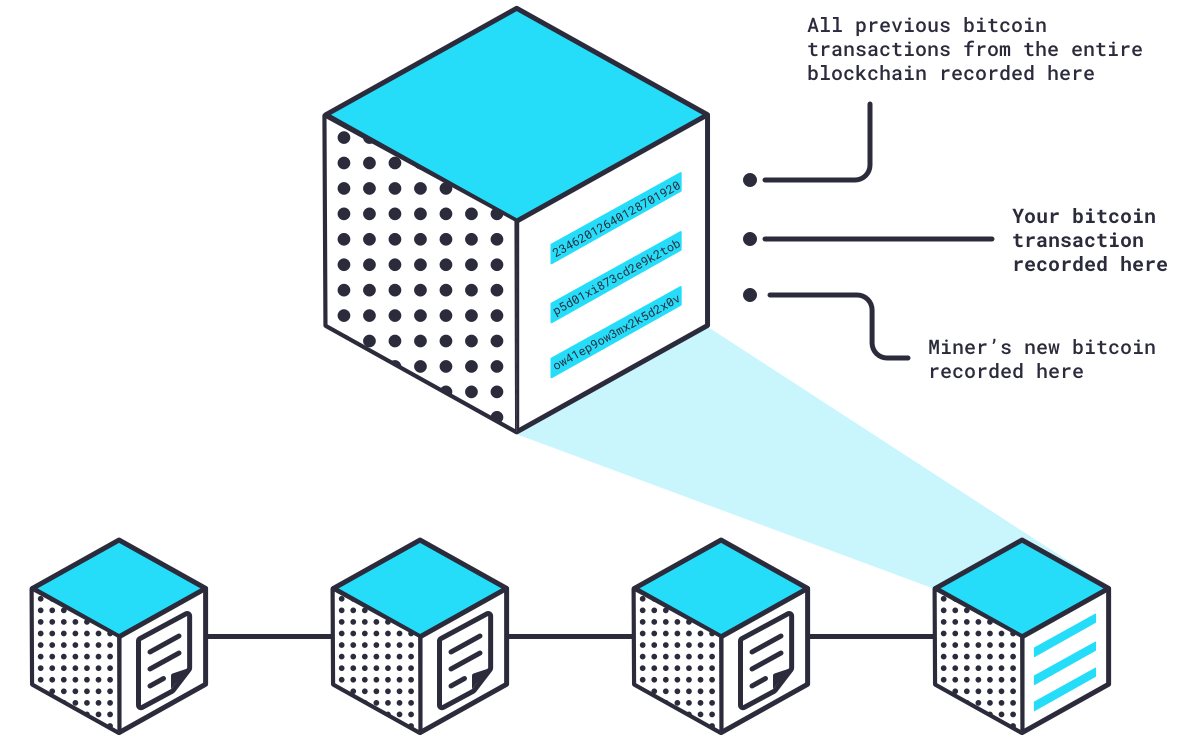
Gemini_Bitcoin_in_5_minutes-Image_8.png

Remember, every Bitcoin full node keeps a copy of the entire blockchain, so the only way an invalid block can be added to the blockchain is if 51% of all nodes agree to its addition. While this is possible, it’s highly improbable, demonstrating another way that decentralization ensures a secure and accurate record of transactions on the blockchain. Valid blocks are added to copies of the blockchain all over the world and Bitcoin miners begin working on the next block.

In exchange for their effort, which is called Proof of Work (PoW), miners are rewarded with new bitcoin. This is the only way bitcoin is created.

So, another quick recap.

  1. Transactions are turned into multiple hashes.

  2. Those hashes are turned into a single hash.

  3. That hash is combined with the hash from the previous block.

  4. Those two hashes are combined with a nonce to create a unique hash for the new block.

  5. The new block’s hash is verified by the network, added to all copies of the blockchain, and miners get paid in bitcoin.

The way that miners get their bitcoin is every mining team adds a transaction to the block in their node that states that they receive the pre-determined bitcoin for successfully mining that block. The team that actually does it, gets the bitcoin because their block is added to their copy of the blockchain, and subsequently all copies of the blockchain across the world. All other mining teams’ blocks are discarded.

So, now you can understand that decentralization and cryptography are the mechanisms by which security of data and trust in the Bitcoin blockchain is established and reinforced. And, that bitcoin is simply a representation of value in the form of a record of ownership on the Bitcoin blockchain.
Deriv.com Next-Gen App

Wednesday, 7 June 2023

What Is an API and How Do You Use It To Trade?

 An application programming interface (API) is a software bridge that allows computers to communicate and execute tasks with each other. You can think of it as a language translator for computers.

Gemini-What Is an API and How Do You Use It To Trade

Summary

An application programming interface (API) is a software bridge that allows computers to communicate and execute tasks with each other. APIs act as computer-to-computer code translators to carry out increasingly complex tasks at hyperkinetic speeds impossible for humans to replicate. Indeed, without API trading, crypto exchanges would be unable to offer customers the depth and breadth of services they provide. Without APIs, algorithmic and AI trading strategies would not be possible.

An application programming interface (API) is a software bridge that allows computers to communicate and execute tasks with each other. You can think of it as a language translator for computers. An API links a trader’s account with a broker’s automated trading system to execute trades quickly and efficiently, and to perform algorithmic (algo) or programmable trades in certain scenarios. APIs have gained popularity as traders realize the benefits of automated trading tools, which allow them to hedge bets into the future, and abandon traditional manual trades. Whether it’s a stock trading API or a bitcoin trading API, the key functions and benefits remain the same.

What Can an API Do?

A cryptocurrency exchange’s API acts as a middleman between you and your broker so you can perform various transactions. These may include buying and selling assets, viewing real-time market data, and executing more sophisticated trading strategies. Cryptocurrency exchanges, for instance, use APIs to offer customers the ability to trade cryptocurrency pairs and carry out basic to high-performance trading through premium trading platforms. Experienced day traders can engage in advanced charting, multiple order types, auctions, and block trading, among other functions.

Top APIs for Crypto Traders

Gemini, Binance, Bittrex, Bitfinex, Coinbase, and Kraken, for example, are some of the top crypto exchanges to offer API trading. For algorithmic traders with customized programs, they offer various ways to connect through popular API protocols such as REST, Websocket, and FIX.

Who Can Benefit From API Trading?

Anyone interested in trading can benefit from using APIs. Traders can use APIs to trade stocks, crypto, commodities, and virtually every other asset under the sun. Traders who wish to develop their own trading strategies can also use niche API protocols such as MetaTrade, which targets currency traders, or charting and futures platforms such as AmiBroker or NinjaTrader, respectively. Those who want to develop trading strategies from scratch can use coding software such as Python, C++, or Java.

Algorithmic Trading: Welcome to Robo-Trades

The next level in API trading is algorithmic, or algo, trading where traders define a certain set of instructions or complex mathematical equations (algorithms) for computer software to achieve. Algo trading can generate big profits at much higher speeds than any human-run trading strategy can deliver. Sometimes called “black box”’ trading in reference to heavily guarded and proprietary trading strategies, algo has been so successful that today roughly 80% of U.S. equities trading is said to be executed by machines. Algo trading has also provided the building blocks for high-frequency trading (HFT). As its name implies, HFT involves very rapid execution — faster than the blink of an eye — of large orders using powerful computer algorithms.

Basic Algo Trading Strategies

There are a number of algorithmic trading strategies that are based on pre-set price, volume, or market volatility patterns, among other variables. Below are some of the most basic strategies:

Trend following

The easiest algo trading strategy is to follow trends in moving averages, which track an asset’s price over time, most commonly the past 50 and 200 days. Traders can also focus on channel breakouts — such as when an asset moves out of a rising or falling pattern, known as a channel — or other technical indicators like the relative strength index (RSI), which lets traders know whether an asset is overbought or oversold.

Arbitrage opportunities

Some traders make money by spotting price differences between exchanges. This practice is called arbitrage. You can pre-set your algo trading program to buy an asset at a low price on one exchange and simultaneously sell it at a higher price on another exchange.

Index fund rebalancing

You can try to earn a profit by following how the pros rebalance their portfolios, or shift assets around for greater profitability. You can watch how index funds — investment vehicles that track a benchmark, such as the S&P 500 or Nasdaq Composite — rebalance their positions from time to time. Algo traders who track such moves can make a profit per trade depending on how many stocks an index fund shuffles around.

Will Artificial Intelligence (AI) Replace Traders?

We can’t talk about algo trading without considering artificial intelligence and its growing role in automated trading. You pre-set certain conditions such as price, volume, volatility, and so on for a computer to execute, then use AI machines to track these strategies’ results in order to fine tune them for higher future profits. As AI provides new insights from analyzing historical data and trading patterns, a growing number of brokers are marrying algo trading with AI to bolster their results — so much so that some wonder whether robots will completely replace human traders in the future.

APIs act as computer-to-computer code translators to enable them to carry out increasingly complex tasks at hyperkinetic speeds impossible for humans to replicate. Indeed, without API trading, crypto exchanges would be unable to offer customers the depth and breadth of services they provide. Without APIs, algorithmic and AI trading strategies would not be possible.

Pros and Cons of Automated Trading Systems

 Are you ready to trust your trading strategy to bots? Read about the advantages and disadvantages of algorithmic (algo) trading.

Gemini-Pros and Cons of Automated Trading Systems

Summary

Automated, or algorithmic (algo), systems across all asset classes execute pre-set orders that can exclude the influence of human emotion or market swings. This is one advantage of algo trading, as emotional trading can result in overtrading, which in turn can trigger losses. Another benefit of algo trading is that a computer-managed system lets you trade multiple accounts and strategies simultaneously. Algo trading can help to reduce the incidence of mistakes made by humans when placing trades and can identify profit and loss (P&L) opportunities much faster than a human trader. Algorithmic trading is not for novice traders. It relies on expensive, complex software and takes place primarily at large investment banks, hedge funds, proprietary trading firms, and regulated cryptocurrency exchanges.

Trading is about making money — not losing it —  but unfortunately, many do, in fact, lose. People often correlate losses with emotional trading or becoming too personally invested in the outcome of a trade. Over-involvement can lead to over-thinking and then to over-trading, which in turn may lead to loss. In the discipline of trading, it can help to stick with a consistent strategy. Automated, or algorithmic (algo), systems across all asset classes execute pre-set orders that can exclude the influence of human emotion or market swings. As a burgeoning asset class with a fast-growing infrastructure, cryptocurrency exchanges have also begun to give customers the ability to execute automated trading strategies through the use of trading bots.

Still, automated trading platforms are not without drawbacks. For starters, computers depend on a strong internet connection and a reliable source of electricity to function. Moreover, some trading strategies are so complex that computers cannot execute them efficiently, and may require constant monitoring and human intervention anyway. So whether you’re an individual investor or a professional trader, you should carefully assess whether or not automated trading systems would enhance or detract from your trading style.

Advantages of Automated Trading Systems

  • Eliminates Trading Based on External Factors: Algorithmic software generally calls for each trade to be programmed, which means traders can avoid reactionary or ill-considered buying and selling based on negative economic or company news, or from fear of missing out (FOMO) on a lucrative asset. Algo trading can also prevent quick-finger transaction mistakes — like accidentally omitting a zero on a sell order price.

  • Provides Opportunities for Backtesting: In trading, backtesting refers to when an investor looks to history for clues about how to invest in the future. With this strategy, you can use historical market data to test whether a certain trading plan will work based on past results. You can then automate that plan rather than guessing and potentially losing funds.

  • Automation Keeps You On Plan: Many traders start out with a trading plan, only to forget about it over time. A common aphorism in the investment community is “plan the trade, then trade the plan.” The latter is much easier if you automate your trades to consistently execute your trading plan in pursuit of profitable results during a particular period.

  • Helps You to Stay Diversified: Trading is all about maximizing profits while minimizing risks, and algo trading solutions can help traders achieve this goal at a much faster and error-free pace than trading manually or with analog tools. Computer-managed systems allow you to trade multiple accounts and strategies simultaneously, and identify profit and loss opportunities through ultra-fast market scans.

 Disadvantages of Automated Trading Platforms

  • Watch Your WiFi and Power Source: Algo trading systems are electronic, meaning they depend on a reliable power source — and more crucially, a strong WiFi connection. If your automated trading software functions on your own computer instead of on a broker’s software, a failed internet connection can trigger a big loss if orders are not fulfilled on time.

  • Over-Optimization: In addition to backtesting, some trading platforms contain an optimization tool. This feature allows you to enter a range for the specified input and tells the computer to figure out which input would have worked the best for your strategy. Some systems have multi-factor optimization capabilities that let you input many variables — combinations of scenarios — to see their effects on the end result. Unfortunately, though an enticing exercise, optimizing a backtest in this way often leads to a system that performs poorly in reality. When this happens, your strategy is said to be “over-optimized,” meaning it’s too complex for the system to apply it in the real world; it looks good on paper only. For this reason, it’s a good idea to start your automated trading practice with small, simple orders and build expertise over time.

  • Algo Trading Software Is Complicated and Expensive: In general, algorithmic trading happens primarily at very large trading firms, such as investment banks, hedge funds, and proprietary trading firms. Because of their resources, these firms generally build their own proprietary trading software. In terms of individuals, some experienced proprietary and quantitative traders also use algo trading software. Quantitative traders usually are savvy enough to build their own software. But, proprietary traders who may not be so tech-savvy must buy the software, either from their brokers if they offer it, or from a third-party vendor. The algo-trading software that’s available to anyone off the shelf is generally inferior in one or more ways — it can contain loopholes, missing documentation, and so on. If you’re thinking of purchasing off-the-shelf algo-trading software, you likely should bring an expert consultant along with you. Further, for the average person, algo trading software is prohibitively expensive.

  • Scammers: Scammers are everywhere, and automated trading systems are no exception. If a system promises something that’s “free” or “too good to be true,” you should be very skeptical. Research the provider of an automated trading system thoroughly before paying any money for its services, and be sure to look at the fine print. Compare and contrast the system with competitive offerings and read customer reviews across a range of reputable websites.

Should You Automate at All?

If you’re trying to trade from your home computer, then an exchange’s server-based automated trading system can help you to avoid catastrophe from a failed personal internet connection. But if you’re wondering whether you should go the route of algorithmic trading at all, then consider it carefully because setting up a viable algo strategy can take a lot of time, money, and technological sophistication. If you’re a professional trader, then algo trading is worth a try to see if it’s a good match for your trading style and temperament.

If you’re a disciplined individual trader with extra time and money to spare and a high tolerance for risk, then you might wish to try your hand at algo trading. But before you launch full scale into it, think about starting with a very basic custom or “wizard” strategy until you’re more familiar with algo trading. A wizard strategy is essentially a template that you can customize based on your own parameters and trading goals. Moreover, some traders believe that mixing automated and manual strategies produces better results. So that also could be a technique to try before you commit fully to algo trading.

Understanding Order Management Systems

 Order management systems built specifically for trading digital assets connect to crypto exchanges to offer services tailored to the global crypto market

Gemini-Understanding Order Management Systems

Summary

In financial markets, an order management system (OMS) automates and integrates tasks to process the lifecycle of a trade order into a single system. These systems were originally developed to solve for delays and a lack of cohesion in traditional trading firms. Over time, OMS software has integrated increasingly sophisticated features and functions — potentially to support cryptocurrency trading.

Understanding Order Management Systems

In financial markets, an order management system (OMS) automates and integrates tasks to process the lifecycle of a trade order into a single system. These tasks include routing the order to an exchange, searching for an appropriate counterparty, and reconciling the order in accounting books. OMSs connect different parts of a market’s infrastructure, acting as its transportation rails, while bringing liquidity and predictability to transactions.

Order management systems can perform a diverse set of functions depending on who is using them. For example, individual traders use an OMS to place buy or sell orders; broker-dealers offer trading services to customers via an OMS; exchanges use order management systems to source liquidity, and market makers use them to track and arbitrage their positions at different venues. Order management systems for cryptocurrency markets serve the same basic functions as those for traditional markets with added crypto-specific features like wallets and custody.

Order Management Systems: Background

Originally, order management systems connected data and processes for the three divisions of a trading firm — the front, middle, and back offices — which together are responsible for generating, executing, and closing trades. In the 1980s, these divisions operated as silos, each with distinct processes and systems that were managed by different people. This lack of cohesion created delays and bureaucratic problems, which in turn affected how fast trading firms could react to market volatility. For example, because their systems could clear ticket backlogs only sequentially, traders were often forced to wait before they could make what normally should have been timely strategic moves.

Order management systems were designed as a solution to these types of problems. The simplicity of a trading firm’s OMS interface conceals a complex web that touches multiple stakeholders, from its customers to trading exchanges and institutional investors.

Recent Developments

On Wall Street, trade order management systems connect the buy side — typically fund managers whose job is to pick high-alpha securities for their portfolios — to the sell side — typically trading floors at investment banks. Technology protocols, such as Financial Information eXchange (FIX) and WebSocket, facilitate standardized communication and data exchange between different systems and enable rapid and concurrent execution of trades. Over time, OMS software has integrated increasingly sophisticated features and functions, such as comprehensive analytics, real-time trading and research snapshots, and capabilities to test out trading strategies. A fast and efficient OMS can be a competitive advantage for trading firms because it enables them to move in and out of positions quickly.

An Order Management System for Cryptocurrencies

There are few large investing firms in the cryptocurrency ecosystem. Further, individual traders, who perform the bulk of crypto trading, must transact using relatively underdeveloped infrastructures. The global nature of cryptocurrencies also means that exchanges are spread out across geographies and operate 24/7. Counterparties for cryptocurrency trades are still sometimes hard to source and liquidity positions can vary between trading venues.

To maximize their chances of a profit, crypto traders often open accounts at multiple exchanges. But, handling these accounts individually instead of being connected to many or all of them at the same time via an OMS, can be time consuming and complex. Crypto traders must set aside extra time (and expense) to collect, consolidate, and calculate their trade data across platforms. And of course, this process is only attenuated in a volatile trading environment.

Apart from a couple of mainstream order management systems that offer capabilities for bitcoin futures trading at the Chicago Mercantile Exchange (CME), most OMSs do not service cryptocurrency trading. Instead, cryptocurrency entrepreneurs have launched OMSs specifically for crypto trades. These systems connect to crypto exchanges around the world and offer a suite of services specifically tailored to the market. For example, they might offer crypto research reports and wallet services at no cost or allow customers to stake or deposit their crypto to earn interest.

Evaluating Cryptocurrency Order Management Services

Until cryptocurrency market infrastructure is completely built out, popular order management systems likely will not integrate crypto trading into their service offerings. If you’re evaluating OMSs targeted at the crypto market, you might want to consider these factors:

  • Speed: Cryptocurrency prices can be more volatile than mainstream securities prices. Therefore, a trade order management system designed for cryptocurrencies must be able to keep pace with price changes and display them with minimal latency, so that traders can respond accurately and quickly to market volatility.

  • Connections to Exchanges: There are more than 200 cryptocurrency exchanges operating throughout the world at this writing. These exchanges present an arbitrage opportunity for traders because cryptocurrency prices may vary across platforms. Thus, a strong cryptocurrency OMS should connect to the most liquid and well-known exchanges for crypto traders to successfully execute their arbitrage strategies.

  • Regulatory Compliance: OMS functionality must allow crypto traders to remain compliant with crypto regulations in their jurisdictions; meaning that the OMS should be able to generate accurate and timely trading reports and other required regulatory documents.